Yesterday, and many days recently, my life has been reduced to something both simple and profound: the inhale and the exhale.
There was a time—not long ago—when I could name myself by my roles. Executive. Leader. Wife. Mother. Builder of things that mattered in the world. I have worked since I was 15, always moving toward something, always holding vision, always doing good work. My life has been shaped by purpose, by ambition, by a deep desire to create impact.
And now, in this season of illness, none of those identities can carry me.
They cannot heal me.
They cannot regulate my body.
They cannot quiet the overwhelm that rises uninvited.
All I have—truly—is my breath.
Yoga has been teaching me this in a way I could not have understood before. Not intellectually. Not as philosophy. But as lived, embodied truth.
Through asana, I find the ground again. The slow, intentional movement of my body reminds me that I am still here. Even when I feel disconnected, even when I feel like parts of me are slipping away, my body meets me on the mat. A forward fold becomes surrender. A child’s pose becomes refuge. Simply arriving becomes enough.
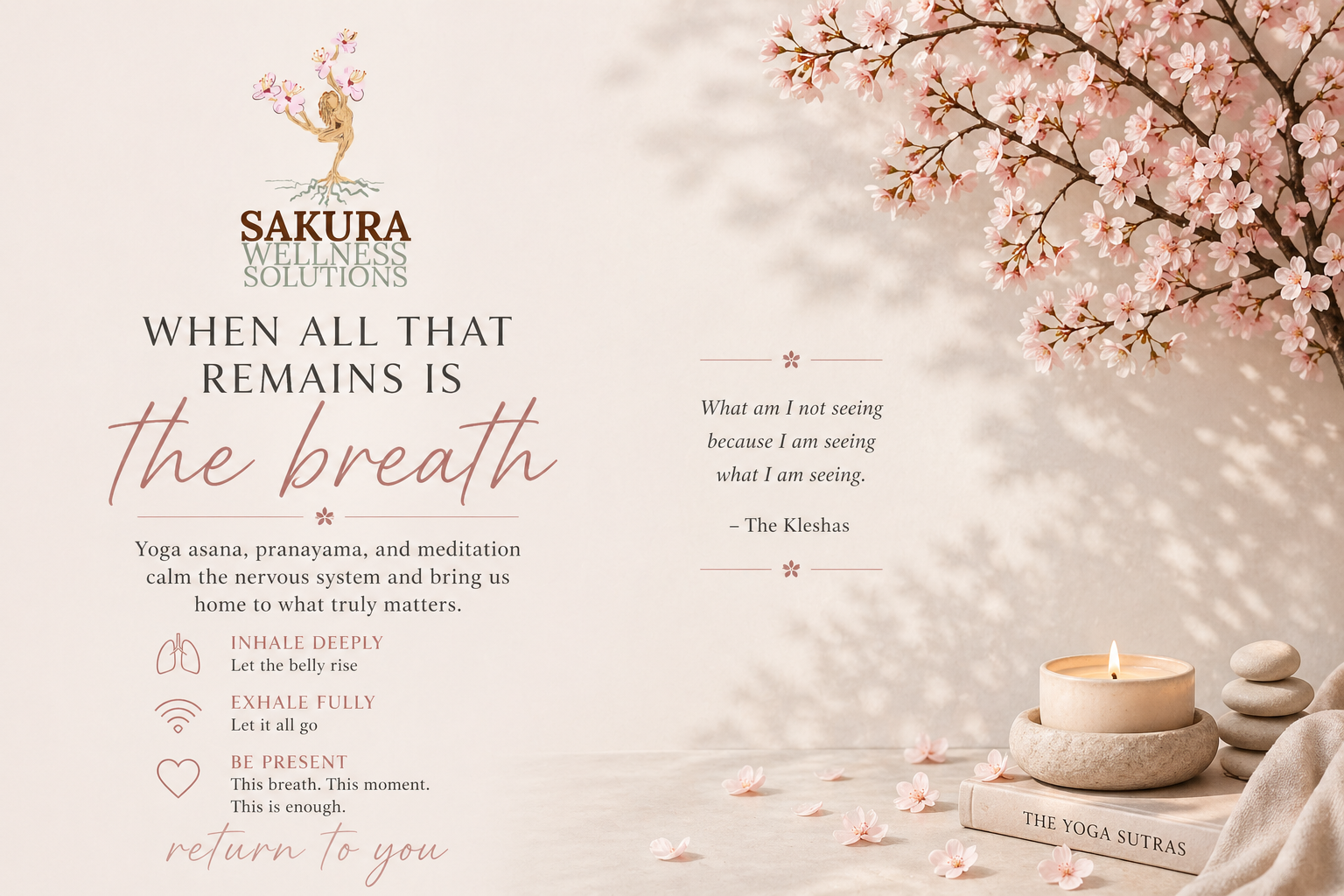
Through pranayama, I am learning to tend to my central nervous system—the place where so much of my fear, my striving, my holding lives. The breath is no longer something happening in the background. It is the practice.
A deep inhale… letting the belly rise.
A long, audible exhale… releasing what I didn’t even know I was gripping.
Again and again.
What science tells us is that this kind of breathing—slow, diaphragmatic, intentional—signals safety to the body. It activates the parasympathetic nervous system, the part responsible for rest, repair, and healing. It tells the body: you can soften now.
But what I am learning is deeper than the science.
I am learning that I have spent so much of my life not breathing.
I have been performing.
I have been achieving.
I have been holding it all together.
In leadership, in marriage, in parenting—I have been doing what needed to be done. And I have done it well. But beneath it, there has often been a subtle constriction. A holding. A forgetting.
A forgetting of myself.
Meditation is where this truth becomes undeniable. When I sit, when there is nothing to do, nowhere to go, no role to play—what remains is awareness. And sometimes, discomfort. Grief. Fear. The unraveling of identities I thought defined me.
The teachings of the Kleshas ask a powerful question: What am I not seeing because of what I think I see?
I thought I was my roles.
I thought I was my productivity.
I thought I was the sum of what I could hold together.
But here, in the quiet, in the breath, I am reminded:
I am not what I do.
I am not what I produce.
I am not even what I can sustain.
I am the one who breathes.
And there is something deeply humbling—and liberating—about that truth.
Because even as things feel uncertain, even as parts of my identity feel distant or unavailable, the breath remains. It anchors me. It steadies me. It brings me back to what is real, what is present, what is still mine.
Right now, the most important thing is not the next goal.
It is not the next title.
It is not even the restoration of what once was.
It is this:
The inhale.
The exhale.
The quiet gratitude for another moment, another breath, another chance to arrive on my mat.
And in that space—somehow—I am finding myself again.