Author: 825151pwpadmin

  • The Beginning of Becoming

    There are seasons in life when something new begins quietly.

    Not with certainty. Not with a grand announcement. But with a subtle stirring in the body. A knowing that something old no longer fits and something new is asking to be born.

    I have come to recognize these moments as sacred, even when they feel uncomfortable. Especially then.

    Becoming is rarely neat. It often asks us to loosen our grip on what has been familiar. To trust what we cannot yet fully see. To remain present while identity, purpose, and possibility begin to rearrange themselves from the inside out.

    Yoga has helped me stay with that process.

    On the mat, I am reminded that transformation does not always look dramatic. Sometimes it looks like breath. Sometimes it looks like staying. Sometimes it looks like softening enough to hear what is emerging beneath the noise.

    There is humility in beginning again. There is vulnerability in allowing yourself to be in process. And yet, there is also beauty there. A kind of honesty that only arrives when we stop pretending to already be who we are still becoming.

    I am learning to honor that threshold.

    Becoming begins the moment we stop resisting what is asking to change.

    This chapter of my life is teaching me that growth is not always about striving forward. Sometimes it is about listening inward. About making room. About trusting that what is unfolding in quiet ways is still real, still worthy, still holy.

    So if you find yourself at the edge of something unnamed, I hope you will be gentle with yourself. I hope you will trust the sacredness of beginnings. I hope you will remember that you do not need to have all the answers in order to honor the becoming already underway.
  • Answering the Call

    There are moments when life asks something of us before we feel fully ready to respond.

    A nudge. A stirring. A quiet but persistent invitation that keeps returning, even when we try to explain it away. I have learned that these moments are often less about certainty and more about willingness.

    Answering the call is rarely convenient. It may ask us to leave what is familiar. To trust our inner knowing. To move without the guarantee of how everything will unfold. And still, something in us recognizes the truth of it.

    I have felt that truth in my own life—in the moments when I knew I could no longer keep living disconnected from myself, in the moments when healing asked for more honesty, more surrender, more courage than I thought I had.

    Yoga has taught me that the call does not always arrive as a loud command. Sometimes it comes through the body first. Through fatigue. Through longing. Through the ache of misalignment. Through the quiet realization that the life we are sustaining is no longer the life that is sustaining us.

    To answer that call requires listening. It requires stillness. It requires enough trust to believe that what is emerging deserves our attention, even if it interrupts the version of life we thought we were supposed to keep living.

    Sometimes the call is simply the truth asking us to stop looking away.

    I am learning that saying yes does not mean having it all figured out. It means being willing to move in alignment with what feels true. It means honoring the invitation, even with trembling. It means trusting that the path will reveal itself as we walk it.

    And maybe that is the deeper practice—not waiting until we feel fearless, but choosing to respond with presence, humility, and faith.

    If something in your life is calling you toward greater truth, greater healing, greater wholeness, I hope you will listen. I hope you will trust what your spirit already knows. I hope you will answer.

  • Coming Home: Self-Care, Yogic Philosophy, and the Grace of Slowing Down

    Lately, I have been thinking about what it means to come home to myself.

    Not the polished version. Not the productive version. Not the version of me that knows how to hold everything together. I mean the quieter self beneath all of that—the one who longs for rest, truth, softness, and enough space to simply be.

    For so many of us, self-care has been reduced to something surface-level. A treat. A reward. A brief interruption before returning to the same pace and pressure that depleted us in the first place. But yoga is teaching me that care is something deeper.

    Care is relationship.
    Care is remembrance.
    Care is the willingness to slow down long enough to hear what the body has been saying.

    Yogic philosophy offers me a path back to that remembering. Through breath, movement, and self-study, I am learning that slowing down is not failure. It is grace. It is how I begin to notice where I have been living disconnected from my own needs. It is how I return to what is true.

    There is a tenderness in this kind of return. It asks me to release urgency. To stop measuring my worth by output. To trust that I do not have to earn rest in order to deserve it.

    And if I am honest, that has not been easy.

    I have spent much of my life moving with purpose, responsibility, and care for others. But there is a difference between living with purpose and living in a constant state of overextension. Slowing down helps me feel that difference in my body.

    It reminds me that self-care is not separate from spiritual practice. It is part of it.

    Sometimes coming home begins with doing less and listening more.

    When I breathe with intention, when I move with gentleness, when I sit in stillness long enough to hear myself again, I remember that I belong to me too.

    That remembering feels sacred.

    So this season, I am practicing the grace of slowing down. I am letting yoga reshape my understanding of care. I am learning that returning to myself is not selfish. It is necessary. It is healing. It is holy.

  • Ahimsa: Ending Self-Violence in Leadership

    Recently, I had the honor of speaking at a Conference for People of Color in Independent Schools, and the experience stayed with me long after the room emptied.

    I found myself reflecting not only on leadership, but on the ways so many of us have learned to lead against ourselves. To overextend. To override our bodies. To confuse exhaustion with excellence and self-criticism with discipline.

    I know this pattern because I have lived it.

    For years, I moved through leadership as a high-performing woman carrying more than was visible. I knew how to achieve. I knew how to hold things together. I knew how to keep going. But beneath that competence was a quieter truth: I was often working against myself.

    Yoga philosophy has given me language for what I could not always name. Ahimsa, the principle of non-violence, is often understood as how we treat others. But I am learning that one of its deepest invitations is inward.

    What does it mean to stop harming ourselves in the name of success?
    What does it mean to lead without abandoning our own bodies, needs, and truth?

    These questions feel especially urgent in leadership spaces where over-functioning is rewarded and rest is often mistaken for weakness.

    I am beginning to understand that boundaries are not barriers to leadership. They are part of what makes sustainable leadership possible. Self-compassion is not indulgence. It is strategy. It is wisdom. It is the practice of staying connected to ourselves while carrying responsibility.

    Yoga continues to teach me that awareness creates choice.

    • Pause.
    • Feel.
    • Choose.

    That rhythm has become a way of interrupting old survival patterns. Instead of pushing through, I can listen. Instead of reacting from depletion, I can respond from presence. Instead of measuring my worth by how much I can endure, I can honor what I need in order to remain whole.

    We cannot sustain leadership while working against our own bodies.

    This is the truth I keep returning to.

    Leadership that harms the self is not sustainable. Leadership that requires chronic self-abandonment is not aligned. And leadership that ignores the wisdom of the body will eventually ask more than the spirit can carry.

    So I am practicing another way. A way rooted in awareness, boundaries, and compassion. A way that honors ambition without sacrificing wellbeing. A way that allows leadership to emerge from wholeness instead of harm.

    And perhaps that is what ahimsa in leadership really asks of us: not perfection, but presence. Not performance, but integrity. Not self-violence, but the courage to lead from a place that is honest, embodied, and alive.

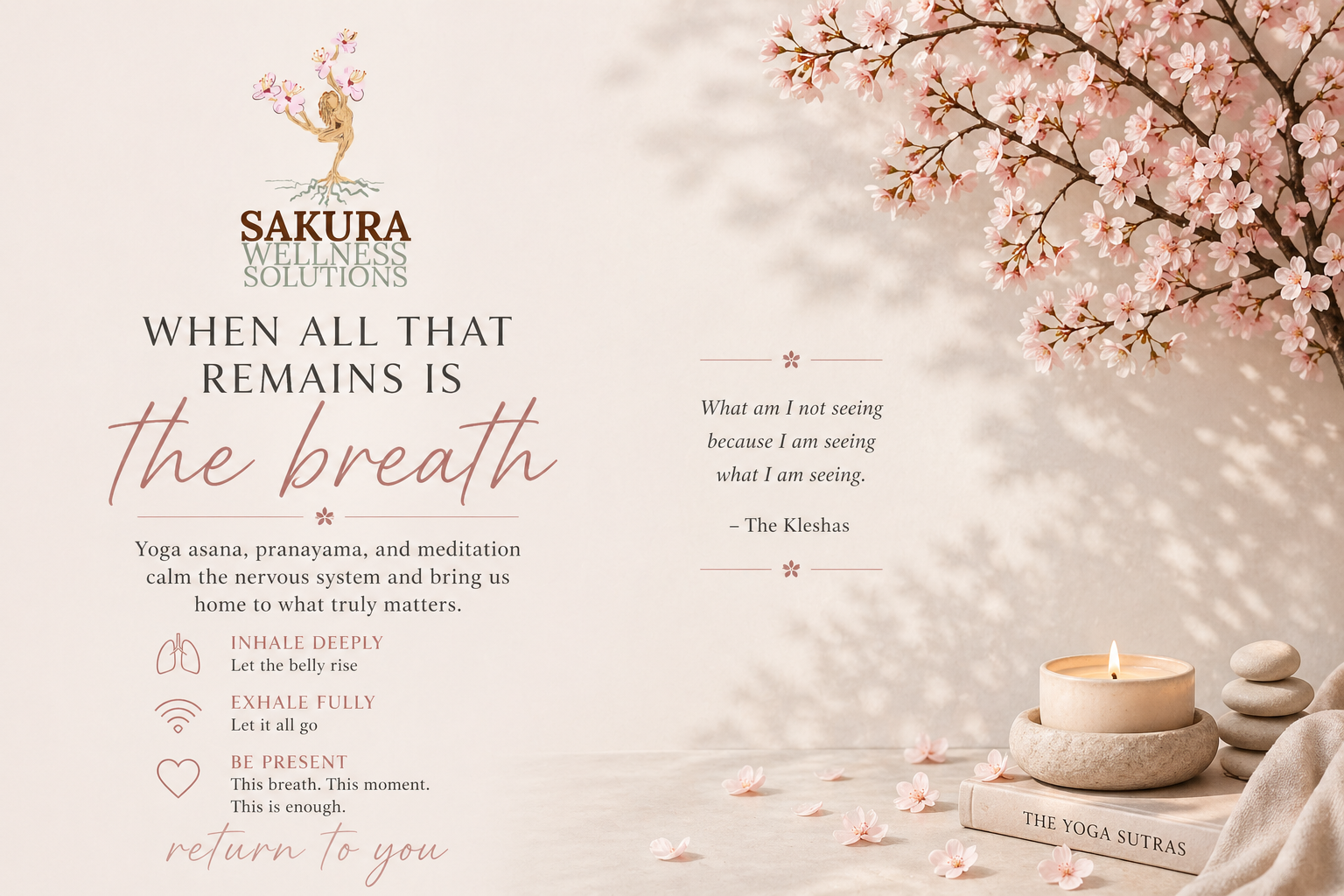
  • When All That Remains is the Breath

    When All That Remains is the Breath

    Yesterday, and many days recently, my life has been reduced to something both simple and profound: the inhale and the exhale.

    There was a time—not long ago—when I could name myself by my roles. Executive. Leader. Wife. Mother. Builder of things that mattered in the world. I have worked since I was 15, always moving toward something, always holding vision, always doing good work. My life has been shaped by purpose, by ambition, by a deep desire to create impact.

    And now, in this season of illness, none of those identities can carry me.

    They cannot heal me.
    They cannot regulate my body.
    They cannot quiet the overwhelm that rises uninvited.

    All I have—truly—is my breath.

    Yoga has been teaching me this in a way I could not have understood before. Not intellectually. Not as philosophy. But as lived, embodied truth.

    Through asana, I find the ground again. The slow, intentional movement of my body reminds me that I am still here. Even when I feel disconnected, even when I feel like parts of me are slipping away, my body meets me on the mat. A forward fold becomes surrender. A child’s pose becomes refuge. Simply arriving becomes enough.

    Through pranayama, I am learning to tend to my central nervous system—the place where so much of my fear, my striving, my holding lives. The breath is no longer something happening in the background. It is the practice.

    A deep inhale… letting the belly rise.
    A long, audible exhale… releasing what I didn’t even know I was gripping.

    Again and again.

    What science tells us is that this kind of breathing—slow, diaphragmatic, intentional—signals safety to the body. It activates the parasympathetic nervous system, the part responsible for rest, repair, and healing. It tells the body: you can soften now.

    But what I am learning is deeper than the science.

    I am learning that I have spent so much of my life not breathing.

    I have been performing.
    I have been achieving.
    I have been holding it all together.

    In leadership, in marriage, in parenting—I have been doing what needed to be done. And I have done it well. But beneath it, there has often been a subtle constriction. A holding. A forgetting.

    A forgetting of myself.

    Meditation is where this truth becomes undeniable. When I sit, when there is nothing to do, nowhere to go, no role to play—what remains is awareness. And sometimes, discomfort. Grief. Fear. The unraveling of identities I thought defined me.

    The teachings of the Kleshas ask a powerful question: What am I not seeing because of what I think I see?

    I thought I was my roles.
    I thought I was my productivity.
    I thought I was the sum of what I could hold together.

    But here, in the quiet, in the breath, I am reminded:

    I am not what I do.
    I am not what I produce.
    I am not even what I can sustain.

    I am the one who breathes.

    And there is something deeply humbling—and liberating—about that truth.

    Because even as things feel uncertain, even as parts of my identity feel distant or unavailable, the breath remains. It anchors me. It steadies me. It brings me back to what is real, what is present, what is still mine.

    Right now, the most important thing is not the next goal.
    It is not the next title.
    It is not even the restoration of what once was.

    It is this:

    The inhale.
    The exhale.
    The quiet gratitude for another moment, another breath, another chance to arrive on my mat.

    And in that space—somehow—I am finding myself again.

  • Alive and Well, Even Here

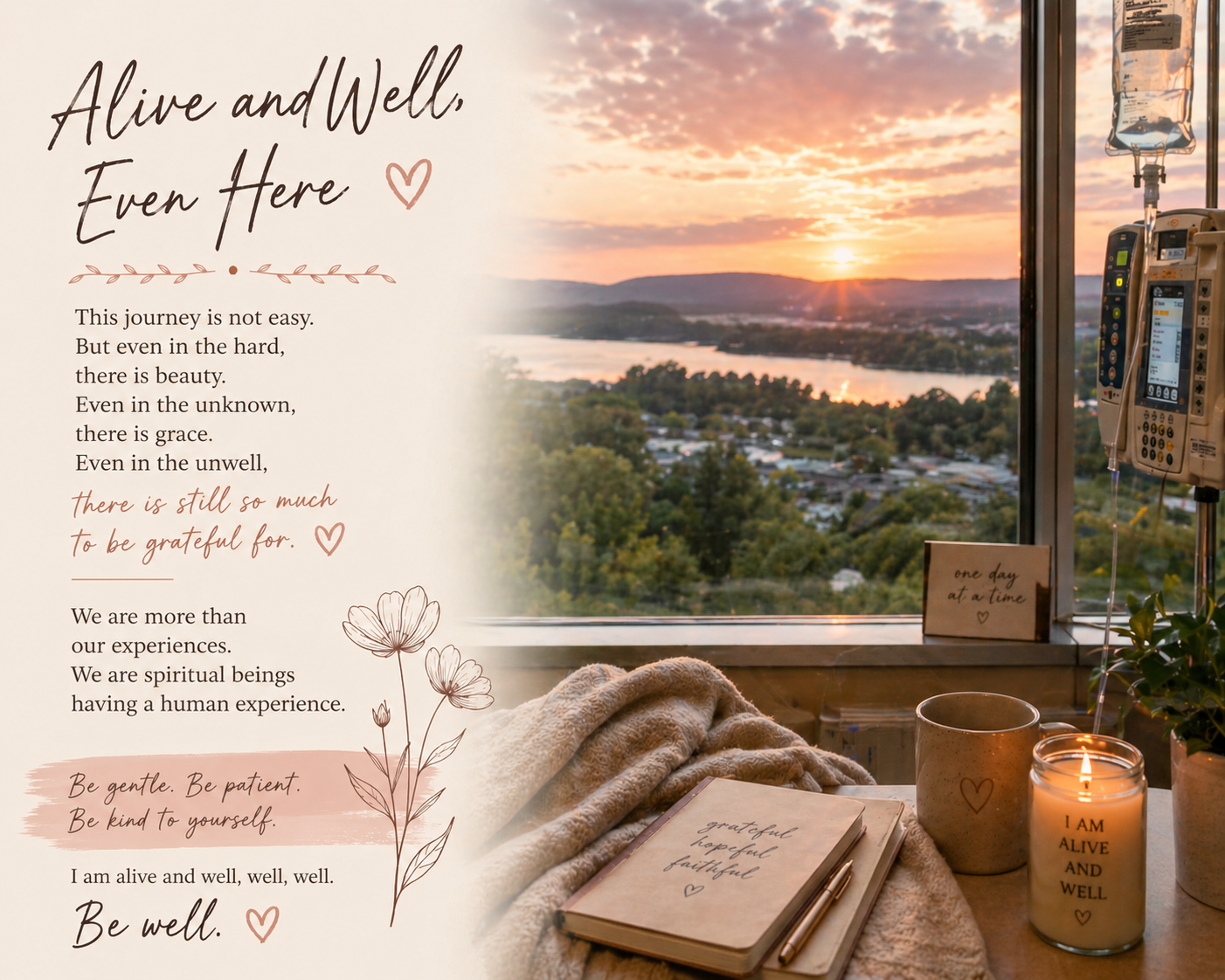
    Alive and Well, Even Here

    Yesterday afternoon, I sat in a doctor’s office receiving care my body needed but my spirit is still learning how to hold.

    First, a shot to shrink my fibroids. Then, an iron infusion.

    There was something almost surreal about it all—the quiet hum of machines, the stillness of the room, the soft rhythm of time moving differently than it does outside.

    And yet, just beyond the window, the view was beautiful. Light poured in. The world carried on as if nothing had shifted.

    But something had.

    There was a moment—maybe several—where disbelief washed over me.

    How does life change so quickly?
    How do we move from health to illness, from strength to surrender, from certainty to questioning?

    This is the road of chronic illness. Not a straight path, but a winding one. A place where the body speaks loudly, and the soul leans in closer to listen.

    My faith keeps me grounded.
    My practice reminds me: I am not my experiences.
    That I am a spiritual being having a human experience.

    And yet, there are moments where those two truths—spirit and humanity—don’t just coexist. They dance. They wrestle. They speak over one another, each trying to make sense of what is real.

    Because the truth is, I felt it all.

    • Sadness.
    • Loneliness.
    • The quiet whisper of why me?
    • And even more tender, why now?

    But beneath all of that, something else rose to the surface.

    Gratitude.

    Not the kind that ignores pain.
    Not the kind that rushes healing.
    But a grounded, embodied gratitude that says: even here, there is something to hold onto.

    • The view was beautiful.
    • The blanket was warm.
    • I have access to medical care and the benefits to support me.
    • I have a car that carries me where I need to go.
    • I have breath in my body.

    And in that moment, I realized something I want to offer to myself—and to every woman walking a similar path:

    Wellness is not always the absence of illness. Sometimes, wellness is the presence of love.

    Love for self.
    Love for the body, even when it feels like it’s failing you.
    Love that says: I am still worthy of care, of softness, of grace.

    There is a path to feeling well, even when the body is not fully well. A path rooted in gratitude, in self-compassion, in the quiet remembering that we are more than what we are experiencing.

    So today, I am holding both.

    The reality of what my body is moving through.
    And the truth of who I am beyond it.

    And I return to the words that feel like a mantra, a prayer, a gentle anchoring:

    “I am alive and well… I am alive and well, well, well. Be well.”

    And even here, especially here, I am learning what that truly means.

  • Ahimsa at Home: How Yoga Is Teaching Me to Mother with Gentleness

    Lately, I have been thinking about what it means to mother without harm.

    Not just the obvious kind of harm, but the quieter kind too. The pressure. The perfectionism. The inherited urgency. The way fear can disguise itself as love and control can masquerade as care.

    As a mother, I have often wanted so much for my children that I did not always realize how much weight I was carrying into the room with me. Expectations. Protection. The desire to prepare them for a world that has not always been gentle, especially for Black children, especially for Black girls.

    And if I am honest, some of that mothering came from survival.

    I know what it means to grow up with the message that you must be excellent, composed, prepared, and above reproach. I know the heaviness of trying to protect yourself by performing well. I know how deeply that conditioning can settle into the body.

    And now, yoga is asking me to pause and consider another way.

    Ahimsa, the yogic principle of non-harming, is often spoken about in broad and beautiful terms. But in my life, it is becoming deeply personal. It is showing up in the tone of my voice. In the expectations I place on myself. In the way I respond when my daughter is simply being who she is.

    It is teaching me that gentleness is not weakness. Gentleness is discipline. Gentleness is awareness. Gentleness is the courage to interrupt what has been passed down and choose something more loving.

    I am learning to notice when criticism rises quickly in me. When impatience is really fear. When the urge to correct is rooted in my own discomfort rather than my child’s actual need.

    And in those moments, yoga offers me a practice:

    • Breathe.
    • Soften.
    • Choose again.

    This is not about getting motherhood right. It is about becoming more conscious inside of it.

    I do not want to pass down the belief that love must be earned through performance. I do not want my daughter to feel that her worth is tied to how well she manages, achieves, or pleases. I want her to know that she is allowed to be whole. Allowed to be learning. Allowed to be held in tenderness.

    Ahimsa at home means making room for softness where pressure once lived.

    It also means extending that same compassion to myself.

    Because I cannot mother with gentleness if I am constantly at war with my own humanity. I cannot create safety for my children while abandoning myself. I cannot teach grace if I refuse to practice it in my own body.

    So this season, I am unlearning. I am listening. I am letting yoga reshape the way I hold my children and the way I hold myself.

    And maybe that is what healing looks like in motherhood—not perfection, but presence. Not control, but connection. Not fear, but gentleness strong enough to break a cycle.

  • Satya in My Body: How Yoga Is Teaching Me Self-Regulation Through Truth

    For as long as I can remember, truth has lived in my body before it ever reached my mouth.

    I have always felt when something was off. I could sense misalignment in a room, tension in a relationship, or the quiet ache of pretending to be okay when I was not. For much of my life, I experienced this sensitivity as a burden. I thought my truth-telling made me too much. Too intense. Too direct. Too unwilling to simply go along.

    But yoga is teaching me something different.

    Through the practice and philosophy, I am beginning to understand that truth is not a flaw. It is a value. It is a form of wisdom. And when held with care, it becomes a path toward self-regulation, not rupture.

    In yogic philosophy, Satya is the practice of truthfulness. But I am learning that Satya is not only about speaking what is true. It is also about becoming honest with myself about what I feel, what I need, and what my body has been trying to say all along.

    My body has always been my first teacher of truth.

    Before I had language, I had sensation.
    Before I had clarity, I had a tightening in my chest.
    Before I had permission, I had a knowing.

    And yet, like so many of us, I learned to override that knowing. I learned to keep moving. To stay composed. To make myself manageable. To suppress what felt inconvenient or too disruptive to name.

    Yoga is inviting me back into relationship with that inner truth.

    Through asana, I notice where I brace and where I soften. Through breath, I create space between feeling and reaction. Through meditation, I witness the stories I have inherited about what it means to be honest, emotional, or fully expressed.

    This is where self-regulation begins for me—not in suppression, but in awareness.

    • Pause.
    • Feel.
    • Choose.

    That sequence is changing my life.

    I am learning that I do not need to explode in order to be truthful.
    I do not need to disappear in order to keep the peace.
    I do not need to force my truth in order for it to be valid.

    Truth can be clear.
    Truth can be grounded.
    Truth can move through a regulated body.

    The yamas and niyamas continue to offer me a framework for this deeper self-study. Svadhyaya, the practice of self-inquiry, asks me to look honestly at my patterns. Where do I abandon myself? Where do I confuse intensity with clarity? Where have I mistaken silence for peace?

    These are not easy questions. But they are liberating ones.

    Because the more honest I become with myself, the less reactive I need to be with others. The more I trust what my body knows, the less I need to prove it. The more I practice truth as an embodied value, the more I can respond with intention instead of old survival patterns.

    Truth is not force. Truth is clarity.

    And clarity, when rooted in breath and awareness, becomes a form of freedom.

    I am still learning. Still softening. Still practicing what it means to honor what is true without harming myself or anyone else in the process.

    But I know this now:

    My body is not betraying me. It is telling the truth.

    And yoga is teaching me how to listen.